Tag: trip highlight

  • Four Day Safari in Tanzania

    Four Day Safari in Tanzania

    Take a peek at what a four-day safari in Tanzania is like, during the month of February.

    Recently, I had the incredible opportunity to go on a safari in Tanzania. This has always been a dream trip of my mom’s, so she and my grandmother tagged along as well. Keep reading for insights into what this was like – from planning to travel and everything in between!

    Booking a Safari in Tanzania

    Picking a time of year for your Tanzanian Safari

    There are multiple factors to consider when deciding what time of year you want to go on your safari:

    • Busy season vs slow season
    • Wet or Green Season vs Dry Season
    • Associated costs & availability

    For our safari in Tanzania, we wanted to pick an affordable option that also worked with my mom’s teaching schedule. While she has summers off, that’s a busier time of year for safaris in Tanzania. Therefore, associated costs are often higher (and temps are as well!). Instead, we opted to go over her school break in February. Added bonus: February is calving season in the Serengeti! Though we were concerned at first about weather, the rainy evenings made for a lot of greenery and beautiful landscapes. Overall, we stayed pretty dry in our safari vehicles as well.

    Zebras on green landscape from safari in Tanzania

    Picking a Tour Group

    When it came to picking a tour company for our safari in Tanzania, we had a few elements to consider. Cost, availability, group size, and sustainability were some of the top factors.

    After requesting proposals from multiple companies, we ended up booking with Tanzania-Experience. They offer several options for lodge, camping, and luxury safaris; we booked the Impressive Tanzania small group safari. We loved that this was an “everyone gets a window seat” experience. It fit the timeframe we needed, and the planning process was also very simple. We were even able to change the booking type to triple occupancy, add on a stay upon arrival, and book a balloon safari!

    One other element I want to emphasize is Africa Experience’s commitment to sustainability. I wanted to be sure whatever company we chose was as ethical as possible not just with wildlife interactions, but community and environmental impact. Even the lodges and camps selected each had their own policies and practices.

    Preparing for your Safari in Tanzania

    Flights & Transfers

    Once we arrived in Tanzania, all travel was included in our itinerary. But how did we get there? Honestly, this was one of the pricier matters to handle – and we regret going with a cheaper option.

    We booked our flights through Priceline, which I would not recommend. Not even two weeks before the trip, my mom’s flights disappeared not once, or twice, but four times. Hours on the phone later, we were able to get her checked into the second and third leg of the flight. Unfortunately, we arrived at the airport to check in for our commuter flight and… her ticket was voided. We are still fighting with Priceline on this as we had to buy a new ticket to JFK.

    Immigration and Visas

    This part of preparation is going to differ for everyone depending on citizenship and passports. My best advice is to look at your governing body’s site, as well as the official Tanzania immigration site. Most travelers will require a visa of some kind; U.S. passport holders at the time of this article require a Multiple Entry Visa. We opted to apply upon arrival as we were all a bit confused on what we needed. That being said, it was a simple process upon arrival. You wait in different lines for application, payment, and confirmation, before you’re able to go through to baggage claim. Questions for our group were pretty standard – how long we’d be there, why were traveling, etc.

    Packing for your Safari

    I’ll write a separate blog on this one to dive deep. For more information on what I packed (and what I actually used), check out my mini series over on Facebook or Instagram!

    Safari Parks in Tanzania

    There are any number of parks one might visit on a safari in Tanzania. Our itinerary covered Tarangire National Park, Serengeti National Park, and Ngorongoro Crater.

    Day 1: Tarangire National Park

    Day one of our safari in Tanzania started with a pickup at the lodge and meeting the rest of our small group. We then set off for Tarangire National Park. Upon arrival, we checked in and had a picnic lunch before our first game drive of the trip.

    Known for its large elephant herds and baobab trees, this park was the perfect introduction to game drives. One of my favorite memories from this entire trip was in this park. Our vehicle pulled over to the side of the pathway to observe a group of elephants grazing. Next thing we knew, the group was on the move, fully surrounding the vehicle, so close I could have touched them (but didn’t!).

    We also saw some of the other wildlife Tanzania is famous for, including marabou storks, Maasai giraffes, zebras, lions, and warthogs. Fun fact: the name of the park can be traced back to/correlated with the term “River of Warthogs.” This comes from the Mbugwe language.

    This park has some man-made elements as well, such as a large watering hole, where we concluded our game drive. We got lucky again that the watering hold had visitors – another herd of elephants! We watched the babies splash around for a while before heading back to the park entrance.

    Day 2-3: Serengeti National Park

    A main reason we chose Tanzania for our safari destination was Serengeti National Park. An avid fan of nature documentaries, I wasn’t going on a safari without seeing it for myself (as well as seeing the Great Migration!). Our itinerary allowed for two days and two nights here, which was perfect.

    The first day in the park, our group got incredibly lucky. After driving several hours to get to the park, we were excited to get started on a game drive. We were met with hundreds of wildebeests and zebras, as well as two types of gazelles. One fun fact about planning a safari in Tanzania is that you can always see the Great Migration at Serengeti NP – you just have to be in the right region of the park for that time of year.

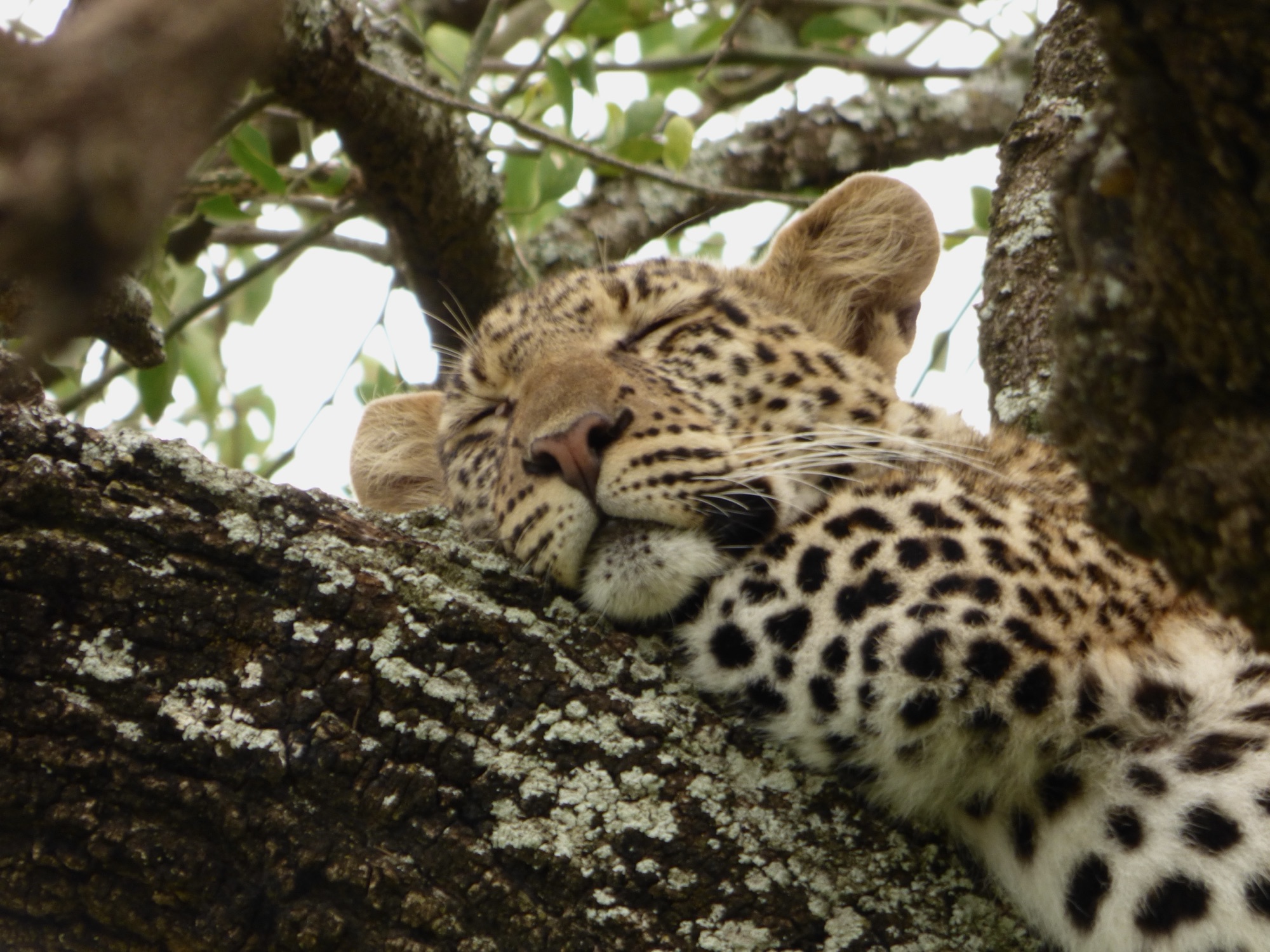
    After a bit of a drive, our guide received some communication for other vehicles – but we did not know what for. We were in luck! There was a leopard spotting! We got to see not just one, but three leopards that day, which is incredibly rare according to our guide.

    Our second day (and drive) we saw even more animals, including a cheetah family and several hyenas with their young. On this day, we learned that hyenas will hide their food in water to avoid other predators and scavengers finding it. We also saw a handful of large male lions – full manes and all!

    Serengeti Balloon Safari

    A true highlight of our time in the Serengeti was a sunrise balloon safari. Our tour company was able to arrange this for us, and the company booked with was Serengeti Balloon Safaris. This was an inCREDIBLE experience that I would recommend to anyone. Seeing the animals from the ground is already amazing, but from the sky? Incomparable. Seeing the migration especially from the air really gave some perspective into how large this natural event really is.

    After the flight, we toasted some champagne in the bush to celebrate. Our drivers from that morning picked us up and brought us to another location in the bush to have breakfast (which was delicious) before bringing us to meet up with our group again. If you’re booking a safari in Tanzania, and can afford the splurge, you can’t miss this experience.

    (Note: this is not a sponsored review, I just truly loved it that much).

    Mobile Camping in the Serengeti

    Another highlight of this particular Tanzanian safari was getting to mobile camp in the Serengeti. While the other stays of the safari were at lodges, this was a campsite that changes location based on Great Migration patterns and location. If you’re not a big camper – don’t worry. This “camp” was in tents, but it had most modern luxuries as well – including real beds, wifi, and a working toilet in the tent. One bit of advice, however: bring bath wipes. There’s a bucket shower, but you’ll probably want to wipe off some dust still!

    This particular experience was a highlight to me due to the fact that we were sleeping actually inside the park. We not only heard lions and hyenas (did you know they sound like birds?) calling through the night, but we even had a giraffe run through our camp! Not only that, but upon entering the site, we saw a trio of lions laying in the path to our camp. Talk about amazing!

    As with other elements of this safari, the camp has an eco-friendly approach, which I also appreciated. If you’re booking on your own (or if you’re looking at tours!) check out Ndutu Kati Kati Tented Camp for your Serengeti stay. On top of all I’ve already said, the hospitality was next level, with the cook going so far as to make my mom a special meal on night two because she’d complimented the dish on night one. Highly recommend it!

    Day 4: Ngorongoro Crater

    The final park visited on our safari in Tanzania was Ngorongoro Crater. Honestly, this was one of my favorite parks, if for no other reason than the scenery. Going in February after the rains really brought out the natural beauty of the area.

    This park is located in Ngorongoro Conservation area, which we’d actually stopped in en route to the Serengeti on day two. We all felt the lookout that day was beautiful – it didn’t even compare to being in the crater area itself.

    Technically a caldera rather than a crater, this area was once as high as Kilimanjaro. Now, it’s home to any number of species – including two species of flamingos, hippos, black rhinos, and the Cape buffalo. We also got to see a number of baby lions, more hyenas, and even a jackal stalking a feasting pride of lions to steal some prey.

    Safari in Tanzania: A Summary

    Overall, I could not recommend a safari in Tanzania enough. Depending on what you’re hoping to see, I also think that February is a great time to go and save on cost as well. That being said, a few things to note are:

    • There are no sighting guarantees.
      • My group was incredibly fortunate to see every animal we hoped for. That will not always be the case, and that’s important to remember.
    • Short stays are great – longer stays are better!
      • For how much time we spent traveling to and from Tanzania, I do wish we had tacked on a few days on either end of the safari itself. I would have loved to see more of Arusha, or even taken a trip to Zanzibar to unwind after all the time in the car.
    • Choose your tour wisely
      • You shouldn’t need to spend a fortune on your safari. That being said, there may be a reason for lower (or higher) costs. Do your own research into why some will cost more or less than others. It could be expected weather and slow season, but it could also be an issue with quality or sustainability.
    • Be mindful of the travel
      • Something that isn’t always talked about is how much time is spent inside the safari vehicle. While the vehicle itself was rather comfortable with the company we went with, you know your body best. Be prepared with anti-motion sickness meds, and be ready for some rough roads.

    Are you looking to book your safari in Tanzania? Check out my socials for even more insight into my recent trip!

  • Best of Peru

    Best of Peru

    Trip Highlights from Peru in September

    Note: As an Amazon Affiliate, I may earn commission on qualified purchases from links in this article.

    My first full day in Peru was spent in the coastal city of Lima. Since we only had one day there, we had to maximize our time. We took a walking tour of the best parts of this coastal city. Some highlights included:

    • Miraflores – a beautiful district full of green space and flowers.
    • Paddington statue – Paddington is based on an Andean or Spectacled Bear. These are native to Peru, and so you’ll find several tributes to him in the country.
    • Historic Centre of Lima – area of consisting largely of Spanish colonial architecture and the Presidential residence.
    • Lima Cathedral – this third reconstruction houses many religious alters and the skull of conquistador Francisco Pizarro. Not to mention, home to black vultures that nest on its roof.

    Day Two: Best of Cusco, Peru

    Celebration in the square

    As we flew into Cusco on a Sunday, there was a religious parade happening in the main square. We were given time to walk around and take it in, as well as enjoy lunch. I had my first real taste of Peruvian empanadas and was sold.

    Cristo Blanco

    Later that day, we took an open top bus up to Cristo Blanco above the city. We took in sights along the route from locals flying kites to Incan ruins like Sacsayhuamán.

    Day Three: Best of the Sacred Valley, Peru

    Moray

    An early alarm clock brought us on our way to the site of Moray. This agricultural site lives in the Sacred Valley and was initially created by meteorites. Incan communities quickly realized that different plants grew at different depths of the crater. We learned from our guide how they implemented terraces to grow things from coca leaves to potatoes and corn. Did you know that over 3,000 types of potatoes and 300 types of corn can be grown in Peru?

    Maras Salt Mines

    Our next stop was to Maras, salt mines that are still in use today. En route we learned the history of these mines. Essentially, there was a point in time where the ocean covered plateaus in the region. Since much of the area is on a fault line, eventually earthquakes turned those plateaus into mountains. The water inside evaporated, leaving behind mounds of salt. Rainwater then began to wash the salt through the mountains.

    When pre-Inca individuals (Maras) discovered the source, they built terraces. These terraces have shallow pools for evaporation to occur, leaving behind salt. Individuals manually stir these pools and collect and carry the salt. There are almost four thousand of these pools.

    The different shades of water show different stages of collection, with brown being the newest. Once evaporation starts, there ends up being three colors of salt: white, pink, and brown. While only the white and pink salt are edible, the brown salt is often used medicinally.

    We took time to walk around the area, taking in the views of the pools and surrounding mountains, before heading to our next location.

    More of Cusco

    We finished our afternoon and evening back in Cusco. Fun fact about Cusco: Its name was actually Qosqo, meaning bellybutton. It was named this because the nation of Tawantinsuyu (Incan empire) came from the city.

    I started my afternoon with a small group learning about and painting our own toritos. These are small bull statues that typically live on top of Peruvian homes for protection.

    Along the walk to paint our tortios, we came across Hatun Rumiyoq Street. This is a unique street where structure on half the street is Incan, while structure on the other half is Spanish.

    Cusco Cathedral

    After our painting, we took a tour of Cusco Cathedral. While photos weren’t allowed inside, we learned a lot about its history, including the art inside. Much of the art was created by Inca slaves of the Spanish. Because of this, and their forced Christianity, they often incorporated aspects of their own beliefs into their art. For example, the Virgin Mary’s dress is shaped as a triangle to represent the mountains, or apus. There is also a famous portrait of The Last Supper, but with Peruvian influence, such as having cuy as the main meal and chicha morada to drink.

    Coricancha (Qorikancha): Temple of the Sun

    We finished our Cusco explorations with a visit to Coricancha, the Temple of the Sun. This site is sadly less than half of what it once was. The Spanish who wrote about it said there was gold two inches thick lining the walls. The gardens spread across the river (now a road, pictured below). They contained life sized gold statues of animals, people, and more.

    Following the Spanish conquest of Cusco, much of this temple was looted and dismantled. Gold statues were melted down, and stone was taken to create foundation for Santo Domingo.

    That being said, our guide taught us much about the history of the site. She also showed us how Incan innovation allowed for structures that withstood the earthquakes of the region. The way that the stones were made to fit together without mortar is still visible in some areas.

    Day Four: Best of a Peru Travel Day

    Millma’s Camelid Sanctuary & Shop

    Our fourth day was a travel day from Cusco to Ollantaytambo, where we’d stay the night before heading to Machu Picchu Town. The day started at a camelid sanctuary and alpaca clothing co-op called Millma’s. Here, we learned about and met the various camelids of Peru – vicuna, llamas, alpacas (two types), and guanaco.

    This location is unique in that they’re legally allowed to care for the vicuna. The vicuna is the national animal of Peru but largely hunted by poachers due to its fibers. They are the softest of all the camelids, but they produce less than half of an alpaca’s fiber production. Because of this, their fiber is highly valuable and sought after. The vicuna on property at Millma’s is young, and came to them from a family that had protected it from poachers. Unfortunately, the baby became attached to humans and would not be safe in the wild.

    In addition to housing camelids, Millma’s serves as a co-op for indigenous women weavers. Each month, weavers from different communities come to Millma’s for an opportunity to sell their products and earn a fair wage. Millma’s prides itself on paying a proper market value for fibers and goods, unlike many cheap tourist stands.

    Urubamba Valley, Mercado Artesanal, & Peruvian Silver

    Along the way to the ancient city of Pisac, we stopped at a lookout over the Urubamba Valley. The valley is named for the Urubamba river. Incan belief was that the river was sacred, as it mirrored the Milky Way galaxy.

    We also stopped at a shop in Pisac to learn about Peruvian silver, from its origins to the common symbolism. Following the silver shop, we were given time to explore the Mercado Artesanal. This market consists of stalls of local artisans selling their wares. Regional goods include pottery, woven products, and paintings.

    Ancient City of Pisac

    Our final stop of the day before turning in was the Ancient City of Pisac. Here, our guide taught us about the history of the region, which actually began before the Inca civilization. When the Inca arrived, they merely improved existing architecture rather than destroy it. You can see an example of this in the ruins pictured below. They also improved existing terraces, making them suitable for agriculture.

    We also learned about the largest known burial ground for the Incan empire. Pictured below, this burial site consisted of graves in the sides of a cliff. Community members would repel down the cliff to bury their lost individuals and small items to take with them into their next life. Sadly, most of these were looted long ago.

    Day Five: Machu Picchu Town & Guided Tour of Machu Picchu, Circuit 3

    Arrival to Machu Picchu Town

    From our hotel in Urubamba, we started our journey to Machu Picchu town. We took a train from Ollantaytambo specifically geared toward Machu Picchu travelers. Pro tip: Pack light for this train, as space is limited. We each took a small soft sided bag and left our bigger luggage in storage back in Cusco since we were returning there the following day.

    We arrived in Machu Picchu Town (known to some as Aguas Calientes) with some time to kill before our bus to the ruins. After dropping off our bags at the hotel, we set to exploring. A friend and I grabbed coffee and breakfast and took tome time to relax. While at breakfast, however, a protest came through the streets.

    We learned that day that the protests were related to government interference over tourism to Machu Picchu. In fact, those same protests later shut down operations to and from Ollantaytambo.

    Circuit 3 of Machu Picchu

    Our first visit to Machu Picchu was to Circuit 3 with a local guide. This is an inner loop close to the ruins. We were taught about the history of the city and given explanations as to all the buildings still visible. Unfortunately, we learned, there is currently mass erosion at the site. This has already lead to loss of access to such areas as the Temple of the Three Windows. Our guide emphasized the importance of being ethical visitors – staying only on designated paths, not bringing in garbage, and using rubber tips if walking aids are required.

    Honestly, no words can describe how it felt to finally lay eyes on this World Wonder. There is an energy and reverence throughout the grounds unlike anything I’ve ever experienced.

    My best advice is to try and go twice in your trip – once with a guide to learn, and once on your own for reflection time. Our tour guide arranged our tickets for us; otherwise, know that they typically book up months in advance. There may be even more limited access in the future due to travel logistics and current erosion. If this is on your list, do your research well in advance.

    This circuit wasn’t particularly challenging for me, as a whole. There were a few steep stairways, but overall it was manageable. I’d recommend it for anyone wanting an interior look, and anyone with more physical challenges.

    Day Six: Machu Picchu, Circuit 2

    Our second day in Machu Picchu Town started with a trip up to Circuit 2 with the option of doing the trail to the Sun Gate. I set out on this trail with the best of intentions, but was definitely met with challenges. Between the altitude, my asthma, and an ankle awaiting surgery, I really struggled on the optional trail. Please go into this with an open mind if you are considering the attempt.

    In the end, I made it about 3/4 of the way up to the gate before opting to turn back. Trip mates of mine did make it all the way. Even if you don’t get to the gate, I’d still recommend checking out the trail. It offers some solitude and unique views of the site.

    Since we were on a time crunch and I was slow moving, I decided eventually to turn back and go to the main lookout point. This is the point many post pictures of. Honestly, I could have stayed there all day, even with the crowds. There’s a great view of the grounds and mountains from above. You can see the Urubamba River. It was truly one of my favorite moments of this trip, even after the struggle I had to get there.

    At the end of the visit, we made our way back to the train station to go back to Ollantaytambo, and then returned to Cusco. I do wish we’d had more time in Ollantaytambo.

    Day Seven: Best Underrated Hike in Peru – Palcoyo

    Hiking Palcoyo was an option added to our itinerary shortly before leaving on our trip. Most have heard of Rainbow Mountain in Peru. However, did you know there’s more than one rainbow mountain?

    The viral “rainbow mountain” is called Vinicunca and is located outside of Cusco. Lately, it’s been a controversial source of tourism. Communities have been affected by the virality, and not always in a positive way. It’s also often crowded and treated as a photo op.

    Rather than go to Vinicunca, our group went to Palcoyo. I’ll be honest with you – it makes for a LONG day. We left our Cusco hotel at 4 am and drove over 3 hours on largely dirt roads. The altitude is high, with the trailhead sitting at 4,700 meters (15,400 feet). All of that said, it was entirely worth the effort.

    These mountains have a rainbow color due to mineral deposits and consistent shifting of the tectonic plates. This creates a distinct “rainbow” on much of the mountains in the area. These colors are more or less vibrant depending on weather conditions and lighting, so keep that in mind.

    This particular hike was quieter than most viral hikes in the area, especially with how early we arrived. The surrounding area is farmland, with llamas and alpacas roaming. Our group was met with and led by multiple chiribaya, or Peruvian shepherd dogs. I’d recommend the hike to anyone (and I’d also recommend bringing hiking poles!). It truly is one of the best landscapes of Peru, in my opinion.

    Returning to Peru

    When all is said and done, my time in Peru was far too short. The highlights throughout this article are the best experiences and places I visited in my brief visit. If I were to return, these are places I’d consider visiting again (especially Machu Picchu!).

    With that in mind, there are other areas considered the best of Peru that I’d love to see upon return. Those include:

    • Huacachina
    • More of Lima (especially to try more food!)
    • Lake Titicaca
    • Arequipa
    • Choquequirao
    • The Amazon

    Until we meet again, Peru!